


There is a particular kind of apartment that lingers in the memory long after you leave it. Usually, it is not the largest home you have visited, nor the one filled with recognizable designer labels. It might be a narrow one-bedroom above a bakery, or a compact terrace house with a kitchen no wider than a hallway. Yet the rooms feel settled, composed, and quietly expensive.
That impression rarely comes from money alone. Small spaces are unforgiving of careless spending: cramming pricey furniture into a modest footprint often looks more anxious than furnishing simply and well. What creates a sense of luxury in a small home is coherence. When square footage is limited, every surface sits closer to the eye, and every decision carries more weight. Proportion, light, material honesty, and the discipline to leave space alone do far more work than a high-end receipt ever could.
Making a small home feel richer is largely an exercise in editing and noticing—learning to see why certain rooms feel calm and substantial while others, even costly ones, feel restless.
The Quiet Authority of Restraint
The fastest way to make a small home look provisional is to fill every corner. In tight quarters, it is tempting to compensate with narrow console shelves, tiny accent tables, and clusters of decorative objects on every ledge. Yet visual noise shrinks a room faster than dark paint or low ceilings.
Restraint reads as confidence because it suggests nothing is being forced. Leaving eighteen inches of bare wall beside a bookcase, or keeping a windowsill entirely clear, creates breathing room that registers as spaciousness. The same principle applies to color and finishes. A small apartment feels noticeably calmer when it speaks a consistent material language: two wood tones rather than five, one primary metal finish, and a tight palette of muted wall colors that carry from room to room without jarring contrast.
Consider the kitchen, often the busiest square meters in a compact home. Clearing the worktop down to three useful, handsome objects—an end-grain chopping board, a dark glass bottle of olive oil, a stoneware crock holding wooden spoons—changes the room immediately. Once appliances and packaging are put away, you notice the light on the splashback and the grain of the cabinetry rather than a queue of waiting chores.
Scale Over Square Footage
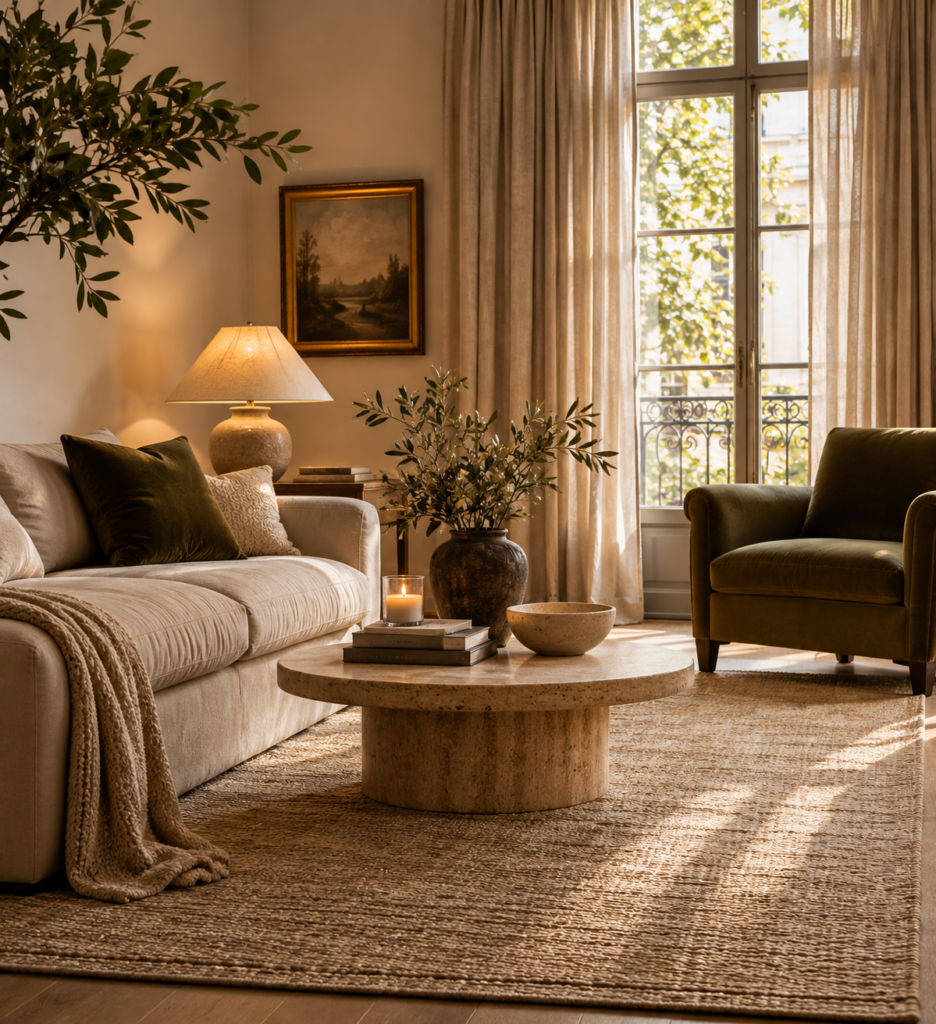
One of the enduring myths of small-space decorating is that small rooms require small furniture. Filling a compact living room with undersized pieces—a shallow loveseat, a postage-stamp rug, spindly side chairs—only emphasizes how little floor exists. It produces the visual effect of a waiting room.
Experienced interior architects often do the opposite: they anchor a modest room with fewer pieces, but allow those pieces real generosity of scale. A clean-lined three-seat sofa paired with one solid armchair gives a sitting room architectural poise. The eye rests on broad, calm shapes instead of hopping from leg to leg.
Textiles obey the same rule. A rug marooned beneath a coffee table cuts the floor into fragments; choosing a flat-woven wool or jute rug large enough to slip under the front legs of your seating pulls the arrangement together and makes the room feel wider. Curtains work similarly. Hanging a simple linen drape just below the ceiling rather than directly above the window frame—and letting it kiss the floorboards—draws the eye upward and lends a modest ceiling unexpected grace. Even inexpensive cotton or linen curtains look tailored when hung at full height and wide enough to clear the glass.
Lighting as Architecture
Nothing flattens an otherwise thoughtful room faster than a single overhead fixture washing every corner in cool, even brightness. Overhead glare eliminates shadow, and without shadow, a small room loses depth and begins to look two-dimensional.
Warm, layered lighting is perhaps the most persuasive tool available on any budget. Instead of relying on the ceiling rose, build pools of light at varying heights: a low ceramic lamp on a stack of books, a small pleated shade on a sideboard, a wall-mounted sconce beside a reading chair, or a soft paper pendant suspended low over a dining table.
Bulb temperature matters just as much as the lamp itself. Anything cooler than 2700K tips a room toward the clinical; warm bulbs between 2200K and 2700K flatter timber, soften paint, and make simple textiles look richer after dusk. Even an ordinary plaster wall gains quiet texture when grazed from the side by a low-wattage lamp.
Honest Materials and the Tactile Test
In a small home, you touch nearly everything you own. Doors open at arm’s length, curtains brush past your shoulder, and the dining table doubles as a desk. Because proximity is unavoidable, synthetic substitutes are quickly exposed. High-gloss laminates, thin polyester velvets, and faux-marble prints rarely age well; they catch light harshly and feel weightless to the hand.
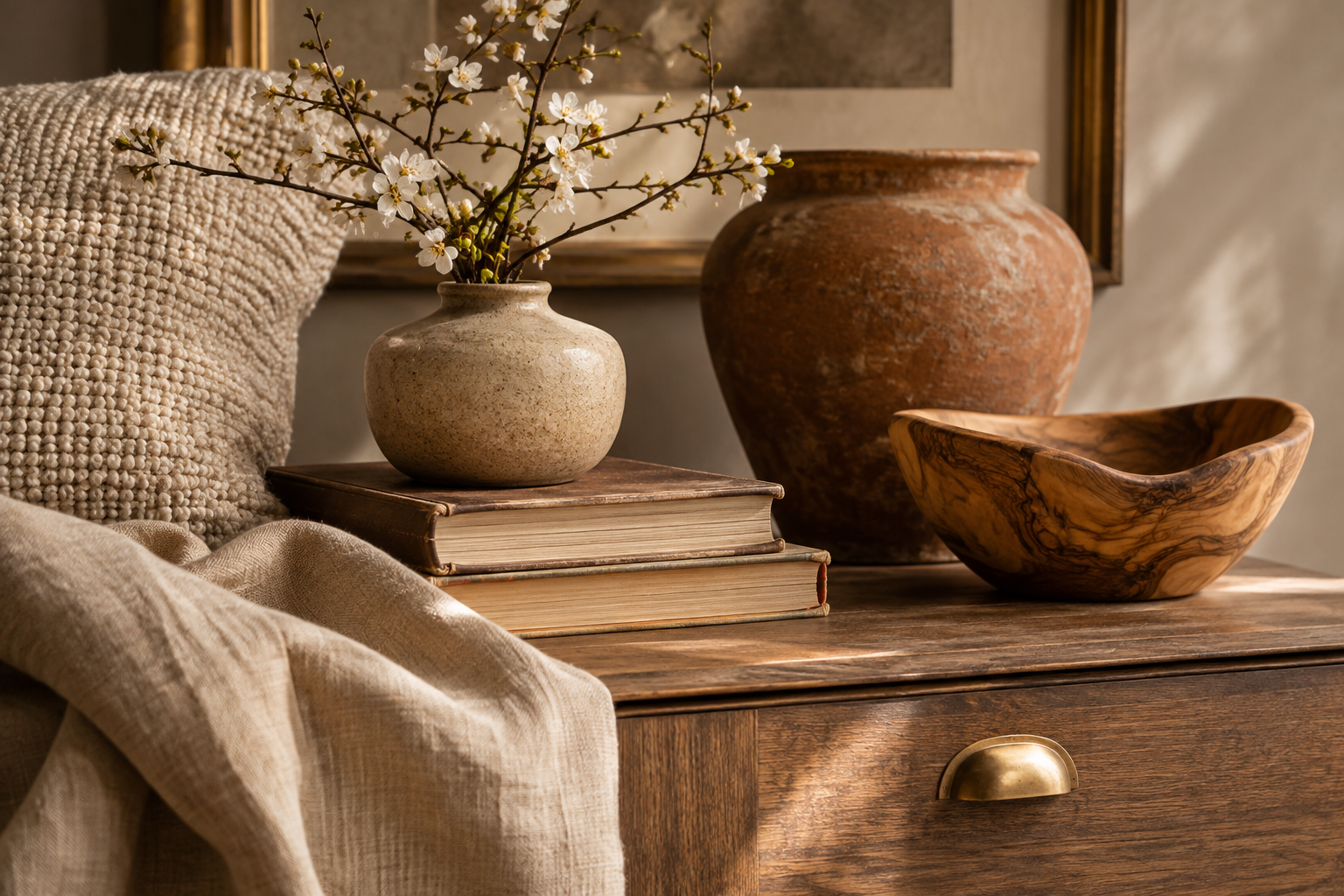
Humble, honest materials carry far more authority. Unbleached linen, boiled wool, oiled oak, raw terracotta, stoneware, and brushed cotton have natural irregularity and weight. They absorb light gently and improve with wear. Texture can also replace ornament: a neutral room built from matte-painted walls, heavy linen curtains, a wool cushion, and an aged timber table never feels bare.
Thoughtful pairing makes all the difference here. An inexpensive birch or pine dining table looks composed beside sturdy secondhand bentwood chairs and heavy linen napkins. A modest sofa loses its generic quality once standard synthetic cushions are replaced with generously filled feather inserts wrapped in textured wool or washed linen.
The Small Details Everyone Touches
If a room’s broad strokes set the mood, its hardware determines how convincing the space feels up close. Builders routinely fit doors and kitchens with stamped chrome handles, brittle plastic switches, and hollow-core knobs. Because we touch them dozens of times a day, these small points of contact quietly define the standard of a home.
Replacing ordinary cabinet pulls with solid unlacquered brass, blackened bronze, or turned oak knobs is a simple afternoon project with outsized returns. Plain kitchen doors or an inexpensive chest of drawers immediately feel grounded and deliberate. The same holds for light switches: swapping glossy white plastic for brushed brass toggles or matte porcelain plates brings subtle permanence to the walls.
Small upgrades apply to presentation as well. Trading flimsy clip frames for simple oak or blackened wood frames with wide, warm-white mat board gives even a vintage postcard or exhibition poster genuine presence.
Objects With a Pulse
Rooms that feel genuinely expensive seldom look as though every object arrived in the same delivery. What separates a lived-in home from a showroom is character—pieces carrying a trace of handwork, age, or personal curiosity.
Books bring warmth and intelligence to small rooms when treated as living objects rather than props. Stacking them both upright and in short horizontal piles creates varied rhythm on open shelves. Mixing books with a few tactile pieces—a hand-thrown stoneware pitcher, a tarnished brass tray for keys, a carved olive-wood bowl—adds depth without crowding surfaces.
Art works best when chosen slowly and hung with restraint. A single charcoal drawing, textile, or framed photograph often commands a small wall with greater poise than a crowded grid of matching prints. Leave breathing space around each piece so it can actually be seen. When every object on a shelf has a distinct silhouette and a reason to be there, the room feels unmistakably personal.
Knowing Where to Spend—and Where Not To
Making a modest home feel refined does not require uniform spending. The secret lies in concentrating funds on the elements that carry physical weight or daily touch, while staying relaxed about simplicity elsewhere.
It is worth spending more on lighting fixtures and shades, natural-fiber rugs, solid hardware, one principal piece of seating with durable upholstery, and proper framing for art you plan to keep. Those anchors establish the baseline quality of the room and travel with you if you move.
By contrast, there is little need to overspend on simple shelving, side tables, dining chairs with good secondhand bones, or bedlinen—plain cotton percale or stonewashed linen in a single muted shade looks restful regardless of label. High-low mixing only falters when budget pieces imitate luxury poorly; when a simple, honest piece sits beside a tactile, well-made anchor, both benefit from the company.
A small home does not need to be disguised, nor does it require theatrical styling to earn admiration. Its real advantage is intimacy. When warm light falls across matte walls, curtains hang with unhurried weight, and the objects around you feel chosen rather than accumulated, square footage stops being the story. The room simply becomes a pleasure to inhabit—which remains the only definition of luxury that holds up once the door closes behind you.
Hi, this is a comment.
To get started with moderating, editing, and deleting comments, please visit the Comments screen in the dashboard.
Commenter avatars come from Gravatar.