







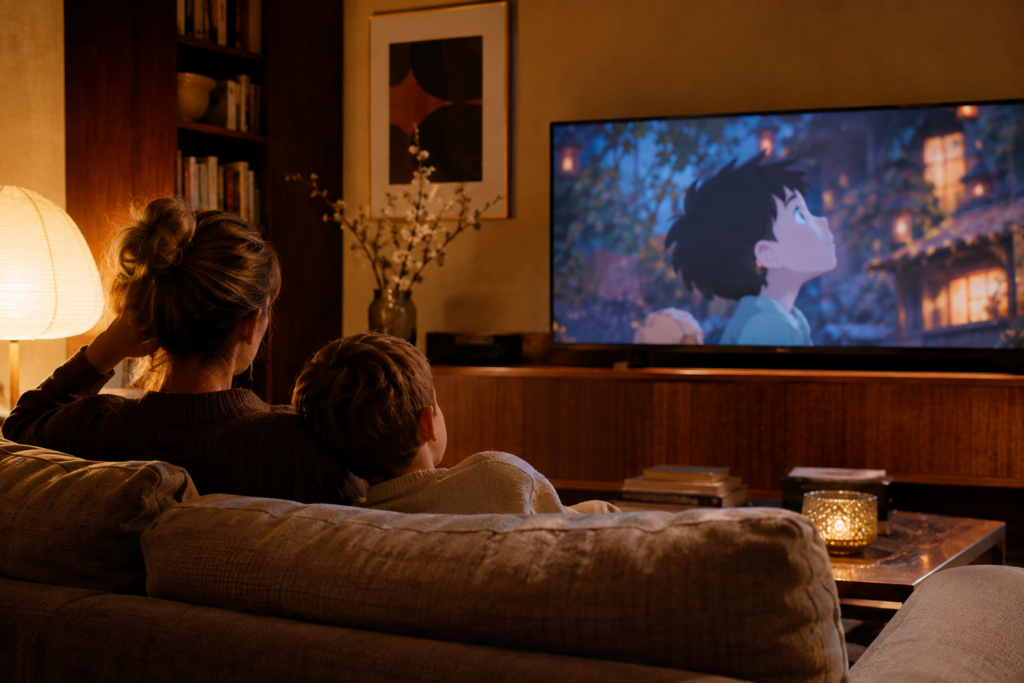
For the better part of fifteen years, modern parenting advice treated screen time like radiation exposure. You were told to count minutes carefully, track allowances with kitchen timers, and feel a faint sting of failure whenever a rainy Saturday pushed the household past the recommended quota. The unspoken assumption was that all glowing rectangles were roughly the same—whether a child was watching a frantic, ad-stuffed algorithm loop or sitting quietly through a beautifully animated film.
Anyone who has actually spent an afternoon in a living room knows that makes very little sense. Thirty minutes of hyperactive, auto-playing video clips leaves most children twitchy, irritable, and weirdly hollow when the tablet switches off. Ninety minutes spent curled on the sofa together watching My Neighbor Totoro, a sharp nature documentary, or an old physical comedy leaves the room noticeably calmer—and usually starts a conversation that lasts through dinner.
The problem was never screens in the abstract. The problem was treating attention like a stopwatch problem instead of a question of taste, pacing, and company.
Stop Counting Minutes, Start Watching the Tempo
Notice what actually happens to a child’s mood during different kinds of watching. Algorithm-driven short video feeds and cheap, over-caffeinated cartoons are engineered with one goal: never give the viewer two quiet seconds to look away. Cuts flash every two seconds, colors scream, sound effects fire continuously, and the moment one clip ends, another launches automatically before anyone has even blinked.
Good film and television move at human speed. Scenes linger. Characters pause before speaking. Music swells, then drops away so you can hear footsteps or rain. When a show gives children time to follow an actual story—feeling tension, curiosity, relief, and humor in proper sequence—their nervous system behaves completely differently. They come out the other end satisfied rather than overstimulated.
Replacing five mindless twenty-minute clips with one proper movie on a Saturday afternoon technically adds minutes to the clock. In real life, it cuts the household friction in half.
Watching Together Changes Everything
The easiest way to turn screens from a solitary habit into part of family culture is simply to sit down on the sofa too. For years, children’s media got pushed onto small personal tablets tucked behind headphones—partly for peace and quiet, partly because parents assumed kids’ shows were too tedious for adults to endure.
Yet co-viewing transforms what happens on screen. When an adult sits beside a child—laughing at the same visual gag, explaining why a character looks nervous, or pausing for ten seconds to answer a sudden question—watching stops being passive absorption and turns into shared experience. You don’t have to turn movie night into an educational seminar. Just reacting together makes the story stick, builds shared family jokes, and quietly teaches kids how to talk about what they see.
Even better, shared watching naturally filters out garbage. Nobody wants to sit through ninety minutes of cynical toy-commercial animation on a Friday evening. The moment the whole room has to agree on what goes on the big screen, quality shoots straight up.
Curating Instead of Policing
Most families spend enormous energy building complicated rules—thirty minutes on weekdays, tokens earned for reading, password locks that turn parents into exhausted courtroom judges—while ignoring what is actually loaded onto the device.
Curating a smaller, far better library removes half the negotiation. Delete the endless video platforms from kids’ tablets altogether, turn off autoplay everywhere, and build a shared watchlist with real standards. Mix sharp modern animation with older classics: Wallace & Gromit, Studio Ghibli, Paddington, Jacques Tati, classic nature series, lively musicals, even well-paced baking or craft shows. Children do not automatically demand loud nonsense; they simply reach for whatever sits closest to the surface. Give them rich stories with real visual craft and wit, and their appetite adjusts remarkably fast.
Keep the Screen Off the Table—and Out of Bed
Fewer rules work best when the remaining boundaries are simple, physical, and completely predictable. Instead of debating daily minute budgets, guard two spaces without exception: meal tables and bedrooms.
Keeping devices out of bedrooms protects sleep without requiring nightly negotiations over five more minutes. Keeping phones and tablets off dining tables—for adults just as much as children—protects the easiest daily chance anyone gets to actually hear about one another’s day. Once those two places stay clear, the living room television stops feeling like contraband and goes back to being what it always was at its best: a warm gathering spot at the end of a long week.
Bring Back Movie Night
There is real charm in making screen time occasional, communal, and slightly theatrical. Dim the lamps on a Friday evening, make proper popcorn in a heavy pot instead of grabbing something crinkly out of a cupboard, pull out a blanket, and put on a film everyone actually wants to see.
Nobody remembers the hours they spent mildly hypnotized by a small tablet in the backseat of a car. Children remember the films they watched shoulder to shoulder with their parents—the scenes that scared them slightly, the jokes everyone quoted all winter, the feeling of staying up half an hour past bedtime because the ending hadn’t arrived yet. When you trade tiny rules for better taste, screens stop feeling like a modern guilt trip and start feeling like culture again.